One Week After Release Day and PR Strategems

Richard Ellis Preston, Jr. is a science fiction writer who loves the zeitgeist of steampunk. Although he grew up in both the United Sates and Canada he prefers to think of himself as British. He attended the University of Waterloo in Ontario, Canada, where he earned an Honors B.A. in English with a Minor in Anthropology. He has lived on Prince Edward Island, excavated a 400 year old Huron Indian skeleton and attended a sperm whale autopsy. Richard currently resides in California.


“I see the poem or the novel ending with an open door.” (Michael Ondaatje)

I am writing this post on Tuesday, July 9, 2013—exactly one week after the release of my steampunk novel, Romulus Buckle and the City of the Founders.  How is it doing, exactly?  I have no idea.  I will be able to see my sales information on Amazon’s Author Central site but it has not updated since the end of June and apparently won’t refresh until Friday.  I can see the book ranking move up and down on the website, but I have no way (and no prior experience) to interpret how that might represent actual sales.  The book did premiere at #1 in the Kindle Store Literature & Fiction/Genre Fiction/Science Fiction/Steampunk category on the first evening, and has bounced around between #2 and #5 since then.  Romulus Buckle was also selected to be included in the Amazon UK Top 100 Kindle promotion and it is doing well in the British docket (#5-#10 in Fiction/Science Fiction/Adventure) because of that.  How it might rise or fall or screw to the sticking place is anyone’s guess, of course.

In my last meeting with my 47North management team I did ask what kind of sales might represent success or failure, but they prefer to take the long view (I understand that, although I am sure there are numbers that send up red flags—but I don’t need to know what those are, at least not yet).  They want to book to do well over time and they dedicate their resources and efforts to that goal.  Some books stumble out of the gate and then gain momentum.  Some books start big and drop off precipitously.  Every book has a different arc in terms of awareness and sales.  I understand that intellectually of course—but the only way for me to avoid endless, worrisome author hand-wringing is to get writing, which is always my salvation from frets over situations I cannot control.  The book will sell the way the book sells.  I am a writer and I write.  Of course, my future opportunities will be shaped by the success or failure of the Romulus Buckle books, but I have written them as well as I can write them, and that is all that I can do.

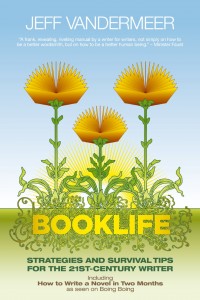
Of course, there is always the author’s Public Booklife and his contribution to his book’s promotion.  These days, with the prevalence of social media and way it can empower the individual, the author is expected to pound the internet pavement and help keep the juice flowing around the book’s PR.  I like engaging with people who are interested readers and I enjoy this aspect of the writing process, although I am already sensing that I have to balance my time between these things and actual writing once the initial publicity rush passes.  Jeff VanderMeer’s Booklife is a great resource when seeking advice on balancing your public and private self and Jeff also lays out tremendous suggestions and strategies for the time you do spend doing your own PR, something which I am still trying to get a handle on. I am fortunate to be in the stable of 47North who can offer my novel to the big guys like TOR, but I want to hold up my end, even if the potatoes I can dig up are small.  Small helps a lot, especially when you are getting yourself in front of avid readers with an appetite for the kind of book you have created.  This is the endgame after all, isn’t it?  To be read.  Every writer wants to be read.  Every writer wants to sell enough books to earn the chance to publish another book.  My own efforts and opportunities provided by well-placed friends have chalked me up for as many guest blogs and interviews as I can handle in the weeks surrounding the book release; it was a big opportunity when Jeremy L. C. Jones gave me the green light to produce a series of blogs about my publishing experience here at Booklifenow.com.

I’d like to address the Booklife list of PR Opportunities and give myself an objective ranking on each so far, let’s say a scale of one to ten, understanding that I have barely gotten started on this whole PR thing.

1)      Blurbs: (7/10) I have approached several more-established authors (both traditionally published and indies) who write in a similar genre as mine and they have been very receptive to my requests for a blurb (once they get a chance to read the book, and provided they honestly have anything nice to say about it, of course.)

2)      Conferences and Conventions (7/10) I am not a big convention-type-of-guy but I did attend Stan Lee’s Comikaze last year.  I am attending Comic-Con San Diego on a professional pass this month.  I’ll be a regular attendee, though I might hand out my book to anyone who wants one outside the steampunk panels!  I’ll also go to Comikaze again.  These are big, easy conventions to attend because they are relatively close to me, but this winter and next year I plan to go to quite a few of the small and more specific steampunk events such as Nova Albion and the Gaslight Gathering.  I’d like to rank my efforts at the end of 2014 and see how I am doing then.

3)      Readings: (0/10) I did one reading at my book release party so far and that is it.  I’d like to do more—I don’t have a problem speaking in front of small crowds—but I have not set anything up.  The same goes with book signings.  But I’d only organize a book signing or reading if I thought that somebody might show up!  That said, I plan to start making the rounds of my local bookstores (Los Angeles has a lot, with the Last Bookstore looking like one of the funnest (yeah, funnest is not a real word – but I like it.)  LA is of course large enough to support genre-specific brick-and-mortar stores (though quite a few have recently closed) and I’ll visit them once the book has had a bit of time to marinate in the outside world.  Getting out there and making friends with bookstore owners and book people is not a high-return form of advertising in terms of numbers, but it is valuable—Jeff gives some great advice on this topic in Booklife, and reversed my thinking about its value.

4)      Guest Blogging: (9/10) I’m gonna give myself a little pat on the back on this one.  I’ve signed up for so many guest blogs, Q&A’s and interviews in the last two weeks that it has taken all of my writing time just to try to fulfill my commitments.  That’s fine—that is what I wanted and it’s been both a blast and a true learning experience.  Guest blogging pieces, especially if your angle compliments the subject matter some of the more topic-specific blogs, can really get your creative mojo running and even give you new insights into your own methods and material.  I have written about the childhood influence of Disney’s 20,000 Leagues Under the Sea on my steampunk, what kind of music I listened to while writing and led a pre-apocalyptic tour of the Los Angeles landmarks which appear in my first book.  My wife (my manager and proofreader) notices considerable upticks in traffic on my own blog after these guest blogs appear.

5)      Interviews: (7/10) Again, I have worked hard on this one, soliciting and accepting all interview offers since the book sold to 47North last year.  This has a lot to do with #10 “Writing your backstory.”  One of my favorite interviews is with Jeremy L.C. Jones in the July issue of Clarkesworldmagazine.com.

6)      Reviews: 47North has been instrumental in getting my books to the bigger advance reviewers and I’ve had a few so far, ranging from raves (Booklist) to ‘mehs’ (Library Journal) to outright pans (Publishers Weekly) and I have been active in combing the internet looking for mentions of the book that might signal a blogger’s review, and I have found a few.  47North has a big A-list of reviewer submissions and I have been active in trying to get smaller, more steampunk specific bloggers to review the book.  Hopefully there will be a good tide of unsolicited reviews (mostly positive, I hope) now that the book has been released.  Exposure, anywhere and everywhere, is the goal.

7)      Writing Your Backstory: (N/A) I have not been seeking to promote the personal backstory on my steampunk book because I don’t feel it is relevant to the project.

To wrap up and repeat, the anxiety associated with a first-time book launch, especially now that an author can witness his or her sales on Amazon, can be a time-consuming, eyes-peeled distraction, a constant re-climbing into the watchtower to see what the dust-obscured hordes outside the gates are up to.  The best antidote to this anxiety is writing.  I’m going back at it.

In this conclusion to my five post installments, I’d like to give a heartfelt thank you to Jeff VanderMeer, Jeremy L.C. Jones and everybody here at Booklifenow.com for providing me with the wonderful opportunity to do these guest blogs.  I hope that I was able to provide a small peek into the life of my book and how Booklife has helped crystallize elements of the writing experience for me.  It was an honor and I’ve enjoyed the experience immensely.

I’d also like to thank all of the readers of Booklifenow.com for their time and attention.  I too, shall be reading here, and I hope to return to the guest post docket sometime in the future.

47North and the Writer’s Grotto

Richard Ellis Preston, Jr. is a science fiction writer who loves the zeitgeist of steampunk. Although he grew up in both the United Sates and Canada he prefers to think of himself as British. He attended the University of Waterloo in Ontario, Canada, where he earned an Honors B.A. in English with a Minor in Anthropology. He has lived on Prince Edward Island, excavated a 400 year old Huron Indian skeleton and attended a sperm whale autopsy. Richard currently resides in California.


“I’m not a very good writer, but I am an excellent rewriter.” (James Michener)

Last time we left off with a conversation about the positive experience I had with my development editor, Jeff VanderMeer.  After the development edit, which is mostly big picture stuff like structure, story progression and pacing, comes the copy edit and the proofread, both of which continually prove to me how poor my own proofreading skills actually are.  I am an excellent speller but it is amazing how one can read through his or her work with an eagle eye, fully expect the pages are clean and then have it returned to them with a typo, incorrect punctuation mark or other error highlighted on almost every page—that’s my experience, anyway.  Perhaps I’ll get better at it as time goes on.  I doubt it, though—and author’s mind is too cluttered with intellectual and emotional story distractions to proof his own manuscript.  As a note, my parents (a retired professor and a retired schoolteacher) also take a pass at my manuscripts, and they also find stacks of mistakes).

My experience with my publisher 47North has been a very positive one.  47North is Amazon.com’s new science fiction and fantasy imprint, and although it is a small publishing house (though growing rapidly) it also stands on the foundation of its gigantic parent.  My first agent, Adrienne Lombardo, had placed 47North on her top wish list of publishers because she felt it was great place for a new, unknown writer to land, firstly for its combination of small and big elements, and secondly because the wide advertising reach of the Amazon website, Kindle, etc. provides immense worldwide exposure for their authors.  I think that I have a great publisher—and in this respect I have been inordinately lucky.  I have greatly enjoyed working with my editor, Alex Carr, and the 47North team I introduced to you in the previous blog; they outlined their battle plan to me in the first meeting and plugged my book into their promotional machine months ahead of its release day.  They have been kind and responsive to my suggestions—as a rookie I don’t have many—and keep me updated on the process.  Alex brought in Jeff VanderMeer to be the development editor and assigned Eamon O’Donaghue as the cover artist, and I frankly don’t know how Alex could have found better people.  The book has gotten a lot of great exposure already, and I honestly believe that 47North is giving my novel its best shot at success—if the book fails, it will not be due to lack of promotion.

Since this is a Booklife blog, I’d now like to take a moment and tell you about my writer’s grotto, which is a compartment in my head.  I don’t like the term cave so much; it smacks of isolation, fear, darkness, misery and leg irons—too close to the awful truth, I suppose.  I jest, but only a little.  The mad scientist’s cubby-hole in the mind to which the writer retreats to do his or her work is both a torture chamber and a paradise.  When describing this intimate place of pain and ecstasy, of desperation and jubilation, I much prefer the more garden-like grotto, which conjures up (for me) the ruined cloisters of Jerpoint Abbey (one of my favorite places in Ireland), a roofless row of carved stone archways made butter-edged by weather, scented with meadow barley and the musk of ancient, sunburnt wood, laced with vines and green, green moss, pleasantly haunted by soft Irish sunbeams and the sounds of trickling fountains and little birds (these last elements are added by my imagination but hey—it’s my brain grotto).  It is here where I go to think and write and sometimes meditate.  It is a safe harbor for me and my creative impulses, a place where I can explore life and my place in it and attempt to strip away the delusions and denials and that protect me from hurts, both real and imagined, and thus open up dark doors I tend to keep under lock and key.  It is a stage where I am both the innocent, naked farmboy running through the fields and the disgraced knight, wretched and old, with the bloodstains of murder on his sword.  My grotto is a wonderful and perilous place of exploration and self-discovery and I love it.

From my (demented?) author’s brain grotto, I’d like to turn to the subjects of physical writing space and writing habit.  In the “Relinquishing all Fetishes” chapter in Booklife, Jeff recommends the Tao-like relinquishing of material items one might associate with the writing life, thus removing obstacles to the actual act of writing.  “These days,” Jeff says, “I don’t care where I am when I write, who I’m with, or if it’s midnight or noon.  I don’t care if I scribble on a piece of toilet paper or in some fancy goatskin lined tome.”  Better advice, writer, thou shalt never find.  Chuck the special notebooks, the favorite pens and the dedicated office space, Jeff advises, and just write whenever and wherever you can.  I really like that philosophy, even if I still cling to some of my writer’s treasures.  Having lost hordes of sparkling ideas in my youth because I wasn’t smart enough to write them down in the very moment they arrived, I now write notes on anything and everything—and in this respect I have found my ever-present iphone to be a wonder machine, at my fingertips with its notepad and audio recording program, and I grab many more of those potential gems in my butterfly net now.  Many storylines or dialog passages have been worked out in a recorded discussion with myself while commuting back and forth to my job in Los Angeles. I used to be a night writer, loving the silence and stillness of the wee hours, but I find the darkness-to-gray-to-sunrise of the early morning to be a better time to write in now—but my wife works on a rotating schedule so my writing schedule rotates with it.  The dedicated office space is probably my biggest transgression, my very special writer’s pet, locked away from the crayons and grubby hands of my children in the den of the house with my precious author icons and walls loaded with bulletin boards for my mosaics of 3×5 cards.  I don’t know if I’ll ever be able to let go of that one.  One of my dearest author dreams is to have a writing room like Rudyard Kipling (sorry, Jeff).

Kipling's Desk

What Drives Your Fiction?

“The rest of it – and perhaps the best of it – is a permission slip: you can, you should, and if you’re brave enough to start, you will.”

Stephen King, On Writing


What’s the primary vehicle behind your words?

A sports car, all angry growls and bright headlights screaming in the night?

A sleek roadster, all curves and purrs cruising languid on a Sunday afternoon?

A cozy sedan with air bags, a sunroof, and the best safety ratings in the country?

A tired old junker, barely holding itself together, let alone its own on the road?

There’s a certain headspace writers slip into when creating words and worlds, but there’s another space, a deeper one, that guides the path of those words–the emotional space. Let’s call it the hurt engine.

Some people thrive creatively when their hurt engine is fueled with anger, others work best with a stream of sorrow or happiness, and some can write no matter what emotions are flowing in the real.

Of the five novels I’ve written in as many years, the earliest two were penned when my hurt engine lived up to the name and was, in truth, running on overdrive. The words flowed and the stories poured out, like the perfect mix of gasoline and air through a carburetor. I wrote the first draft of the first novel in forty days and two weeks later started the second. Thirty days later, that first draft was done, too.

Unfortunately, both novels needed heavy-duty edits/rewrites because while the words were driven by hurt, they were twisted by it too. Had I perhaps edited the first novel before penning the second, I might have realized what I’d done wrong. Live and learn, right?

Imagine my surprise when I started the next novel and the words didn’t have the same flow. It didn’t take long to figure out why. My hurt engine was running on a different fuel. I won’t lie, I missed the rush. Instead of zipping along at 95, I was stuck on 50. But I finished the novel nonetheless. The story is cleaner, but I’m a pantser, not a plotter, so my first drafts always have a bit of rust on their edges. My motto is “first draft is for story, second draft is for pretty.”

Sometimes the hurt engine doesn’t affect productivity, but it changes the flavor of the prose. I can tell what was fueling my hurt engine in my fiction by the word choices I make, by the staccato rhythm or the lyrical quality of the sentences.

I’ve since learned that I can trick the hurt engine when needed. I’ve written a story that required a certain taste of sorrow, and even though I wasn’t feeling sad at that moment, I pulled the necessary fuel from a memory and poured that into the story instead.

I’ve also learned how to set things on literary cruise control by swallowing the emotional fuel. The hurt engine becomes a quiet place of numbness. And yes, I can tell what stories I’ve written in that place, too.

Last year I wrote the most deeply personal short story I’ve ever written. I had to dig deep into a place I don’t like for the fuel, but the story is probably my strongest work ever. It sold quickly and well, but no, I’m not going to tell you which story it is.

The only stone in my tire is anger. I can’t write when I’m angry. At all. Sure, I can fire off an expletive-filled email, no problem, but fiction? Impossible. Fortunately, my anger burns bright and hot and then fades. I might still be angry, but the rage fuel tank is empty. And then I get back to work.

So what about you? What fuels your hurt engine? Do you escape your emotions when you write or do you let the emotions paint your words? Do you get blocked when you’re not in the thick of your preferred emotional space?

Try changing your fuel and let’s go for a drive.


Visiting the Planet of Jeff Vandermeer

Richard Ellis Preston, Jr. is a science fiction writer who loves the zeitgeist of steampunk. Although he grew up in both the United Sates and Canada he prefers to think of himself as British. He attended the University of Waterloo in Ontario, Canada, where he earned an Honors B.A. in English with a Minor in Anthropology. He has lived on Prince Edward Island, excavated a 400 year old Huron Indian skeleton and attended a sperm whale autopsy. Richard currently resides in California.


“Our life is what our thoughts make it.” (Emperor Marcus Aurelius)

As of my last blog, Romulus Buckle and the City of the Founders had been written, agented and sold.  The first two books of the series (the second eventually being titled Romulus Buckle and the Engines of War) were now in the stewardship of 47North and my editor, Alex Carr.  47North had been looking for some steampunk to flesh out their fledgling imprint’s catalogue, and Alex was willing to bring on first-time novelists.  My book had been agented and sold very quickly, but then it took six months for my agency Trident Media Group and Amazon to work out a boilerplate contract—ah, there is always waiting somewhere along the line.  Once the contract could be signed, Alex set up a conference call and immediately introduced me to our 47North team which included Patrick Magee (Author’s manager), Katy Ball (Marketing manager) and Justin Golenbock (PR Manager).  All of these people have been kind, attentive and crackerjack, and I shall talk about my positive experience with 47North in a later blog.

I should make a note that, along the way, my first agent Adrienne Lombardo made the difficult decision to move on into another aspect of the publishing industry, and I was picked up by Alyssa Eisner Henkin at Trident Media Group.  Alyssa has been great, and very supportive of my plans for the future.

Enter Jeff VanderMeer.  Alex wanted to put me under the wing of a development editor who was both familiar with the steampunk genre and a master of story, so he assigned my books to Jeff.  Do you assume that I shall speak kindly of Jeff here on this platform of his own construction?  Should I speak the truth?  Perhaps I shall set fire to the place, setting the curtains ablaze before leaping from the stage, screaming “Sic semper tyrannis!” tearing away the lamb’s mask from the face of the monster?  Fortunately, I have no awful tale to tell.  These two books were my first experience with a development editor—although I did spend a decade having my screenplays (some, not all) disemboweled and reworked by producers—and I was aware that it could be an excruciating process for everyone involved, especially if the editor was trying to rewrite the book.  It was a lot of work at times—and you have to muster a new perspective as you return to a sentence, passage or chapter that you were once certain was finished—but Jeff brings an intelligence, empathy and humor to the table that infuses a lot of enthusiasm and joy into the work.  Yeah, it can be a long, hard haul for both of you, but it’s all about making your book better.  As a writer himself, Jeff put on kid gloves whenever he came near the innards of my story, not wanting to disrupt or alter my vision in any way, shape or form.  His job was to make the communication of my story, the telling, clearer, cleaner and more effective.  Jeff had his work cut out for him, especially in the structure of the first third of the first book, where a writer of speculative fiction must delicately balance all of the introductions of characters, environment and story.  Jeff’s experience and deep understanding of my tale, its characters and the world it is set in—what my books are at their core—allowed him to generate notes and suggestions which resulted in vast improvements in the way the novels read without ever altering the story.

Jeff is a super development editor to work with, and I thank my lucky stars that Alex Carr decided to bring Jeff in to work with my little books.  Jeff is now heavily invested in a huge trilogy project of his own (Southern Reach, as I am sure you are aware) but I hope he can stay on as the development editor for the rest of the books in my series, provided 47North continues it in the new year.  I would also like to add that Jeff and his wife Ann have become my friends and have been wonderfully supportive of my new writing career.

I must admit here that before I met Jeff, I had not read any of his books.  I had heard of him, but my science fiction reading until recently had usually involved revisiting the classics of my youth such as Verne, Wells, Heinlein, Asimov and Vonnegut.  Since then I have read his City of Saints and Madmen—what a delightful, dark, spin through the fantastic— and of course Booklife.  Needless to say, the rest of Jeff’s works are now high on my reading list.