Six Elements That Drive Your Personal Booklife

Your Private Booklife constitutes your core activities: the engine that drives your creative life. It has six essential pillars, or qualities:

• Curiosity
• Receptivity
• Passion
• Imagination
• Discipline
• Endurance

Try to encourage these qualities in yourself and others. Draw them out into the open if necessary, and at times allow yourself to indulge in them. In all ways be generous to yourself so that you can be generous in your work.

Although several of these qualities are useful to your Public Booklife, nowhere are they more necessary than in your Private Booklife. Let’s explore them further…


(What does this photo spark in your imagination? How does it make you curious? Image by the highly recommended Jeremy Tolbert.)

Continue reading →

Booklife: The Tale of a Cover

Print
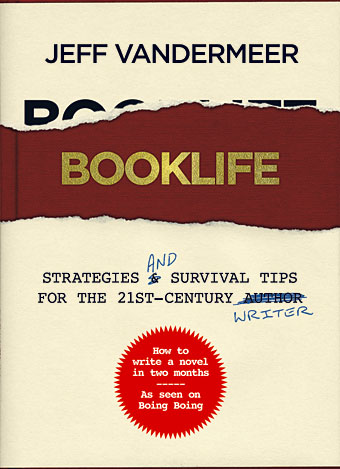
(Booklife in an alternative universe.)

Master designer John Coulthart created Booklife‘s distinctive cover. But what that final cover can’t show readers is the long, drawn out process of getting to a great cover. That process was partly my fault and partly an inherent problem in creating something unique for a writer’s manual. After finalizing Booklife, Coulthart wrote about the experience, including several cover drafts from along the way. In doing so, he gives an interesting and invaluable behind-the-scenes perspective. For your enjoyment, and those who might’ve missed it, we reproduce his original post below the cut.

Continue reading →

The Pillars of Your Public Booklife: What Do You Find Most Important?


(Roller derby or the Internet flashing by? Photo by the highly recommended Jeremy Tolbert)

Today, a focus on your Public Booklife, or career, and on Friday, your Private Booklife, or personal creativity, with a book covers post for kicks on Thursday…

More than two thousand years ago, the strategist Sun Tzu wrote that the warrior skilled in indirect warfare is as inexhaustible as Heaven and Earth, as unending as rivers and streams, and passes away only to return like the four seasons. Curiously enough, these classic lines could as easily describe the relationship between you and the Internet, given how quickly a writer must adjust to and take advantage of opportunities. It also reflects the ephemeral quality of the Internet. Because of the vast amount of information and opinion posted every single day, every hour, every minute—supplanting the information posted a minute, an hour, a day before—you need to be fluid and flexible while retaining inner calm and balance.


(Sun Tzu, thinkin’ about book publishing)

Continue reading →

Booklife Essentials: Knowing the Lifecycle of a Book


(The remains of writers who never did understand the lifecycle of a book. Photo by the highly recommended Jeremy Tolbert.)

In this first week at Booklifenow, it’s important to provide a breakdown of the lifecycle of a book. While this information might appear basic, very few first-time authors seem to receive it prior to publication. As a result, many writers are unable to take advantage of possible opportunities. Even worse, not knowing what happens when results in the following unfortunate scenarios: writers asking for things at the wrong time, writers not understanding their role during a given part of the process, writers being really irritable about quick turn-arounds on tasks like approving edits, and editors wasting time answering questions that could be forestalled with some simple documentation.

If there’s one way that agents and editors could help their writers it would be by not assuming any prior knowledge of this lifecycle—although it is true that the process can change from publisher to publisher. (The lack of internal documentation of process at most publishers is a bit of a crime.)

The process set out below the cut constitutes a general breakdown of events and timing issues that occur during the lifecycle of a book. A week-by-week breakdown would be too long for a blog post. (I recommend supplementing the information I give you below with Colleen Lindsay’s excellent post on working with publicists.)

However, the traditional lifecycle doesn’t approach the “book” as a mutable object that can take many different forms in the modern era. If you boil the process down, stripping off the detail and making a “book” a more fluid creature, the lifecycle roughly becomes:

• Creation and perfection of content.
• Acquisition of a platform (or format) for the content.
• Creation and perfection of the “skin” (aesthetic) and context for the content.
• Accessibility to the content.
• Visibility for the content.

In creating your plans for your book, always keep this simplified version of the lifecycle in mind. It helps focus your efforts by reminding you of what’s important.

Continue reading →