A Critique Template for Authors and Writer’s Groups

Patrick Hester is an author, blogger and Hugo Nominated Podcast Producer/Host who writes science fiction and fantasy. He is represented by Bob Mecoy for his fiction. His Functional Nerds and SF Signal weekly podcasts have both been nominated for Parsec awards and the SFSignal podcast is nominated for a 2012 Hugo Award. You can usually find him on twitter when he’s not writing (or even when he is).


A couple of years ago, I wanted to take the next step in my journey to become a published author. For me, that meant joining a writer’s group and getting some feedback from other authors. I found a well established group (founded in 1996) with a good mix of authors (folks who write poetry, science fiction, fantasy, horror, general fiction) and, after a few months of visiting (similar to auditing a college class except I was expected to read all of the material and comment/critique as well), I was welcomed as a member and could submit my own stories.

The critiques I received were well thought out, composed and, most importantly, helpful. So much so, that I started feeling guilty about my own critiques. At times, I would read a submission and stare at a blank page without a clue what to write. Over the next few months, I noticed a pattern. Some folks talked about plot, others were focused on characters, sentence structure, syntax, grammar and even dialogue. No two critiques were the same but when you put them all together, you had the big picture. I wanted to reciprocate and offer up the best critiques possible, so I created a form – a critique template I could use for every submission. With it, I can deliver a consistent and, more importantly, useful critique to the author.

Today, I’d like to share that form with you and look at each section.

Header

Here I have the Story Title, Author, Date and my own contact information in case the author wants to follow up with me later. In General Thoughts, I want to summarize my Initial Impression of the story, list the Pros and the Cons and deliver the Bottom Line – did the story work for me?


Plot

How was the Pace and Flow? If I struggled reading through for some reason, or couldn’t stop turning the pages, I need to note that here. What were the Strong Areas of the plot? Maybe it was the development of the main character’s backstory. Weak Areas –- was there an info dump that put the brakes on? Loose Ends – you mentioned a snickerdoodle in a way that made it seem important, but never returned to it or explained why. Stand Out Moments –- Holy crap that was the best fight scene ever! Stumbling Blocks -– your faster-than-light travel depends on thousands of gerbils running in little exercise wheels, and that just doesn’t work for me… Comments –- add anything about the Plot that doesn’t fit into the spots above.

Characters
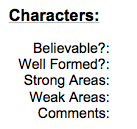
Are the characters in this story Believable? This is subjective, I know. Did you believe that the cop in the story would rob someone? Would the drunk anti-hero save a kitten from a burning house? Are the characters Well Formed? Is there enough detail to let you immerse yourself in the character? What are the Strong Areas of the characters? What are the Weak Areas? Comments – add anything about the Characters that doesn’t fit into the spots above.

Sentence & Paragraph Structure

People either have a lot or a little to say about this section. For me, I narrowed it down to two areas where I feel comfortable commenting: Vocabulary and Word Territory. Vocabulary is important (especially in a short story) and I like to point out where someone has done really well or where they could improve by changing out just a few words here and there.

As for Word Territory, well, this is basically where the author uses the same word or phrase enough that it stands out in the text. I tend to circle these words on the manuscript, drawing lines between them so the author can see them flipping through. Then I list the major instances here. Example: “Search your document for ‘that’, ‘quickly’ and the phrase, ‘working up the courage’ – you use these a lot.” For myself, I recently cut the instances of the word ‘that’ in my novel manuscript down from 1,147 to 659! Comments – add anything that doesn’t fit into the spots above.

Dialogue

Even if you get everything else ‘right’, a character’s dialogue/voice can take the reader out of the prose if it doesn’t flow correctly or feels forced or wrong. I have personally had people point out a bit of dialogue that they felt belonged to a different character in the manuscript – and they weren’t wrong. In this section, I point out Strong Areas that stood out to me, and Weak Areas that could use some work. Comments – add anything that doesn’t fit into the spots above.

General

This section is for a couple things that don’t fit anywhere else: Readability and Conflict. Readability goes to the manuscript as a whole – is it readable from start to finish? Conflict is about the conflict within the manuscript, the challenges that the characters have to face or work through. Did it work for you? Was it believable? How about the resolution(s)? The Comments space is for all other comments or thoughts you might have on the manuscript that just didn’t fit in a section above.

Bullet Points

As I am reading through a submission, I might have a thought or reaction to a scene, passage or bit of dialogue. I put a number and circle it at these points, then use the Bullet Items section to gather those thoughts for the author.


There you have it –- my Critique Template. This is not meant to be the definitive source, just a starting point. Many people in my group have already modified this template for their own style and to include areas they prefer to comment on. You can too -– I’m offering up this template as a free download. Use it well.

As a last thought, don’t focus on fixing everything. Be positive where you can and provide encouragement when it is deserved. Yes, you want to help the author produce the best story possible, but your critiques should be constructive, not crushing.
Planting the Decision Tree

Monica Valentinelli is an author who lurks in the dark. Recently, she released a science fiction novella titled “Redwing’s Gambit” which was based on the Bulldogs! RPG. She has over a dozen short stories published and two novellas with more on the way. For more about Monica and her work visit her website.


At some point in your career, you’re going to get some advice on what to do with your written works or your future as an author. Maybe the suggestions will originate from a peer or your mentor. Maybe it’s from an old teacher or a friend of yours. Maybe you spot something on a website just like this.

Getting inundated with advice isn’t always a good thing, because often pieces will conflict with one another or worse – derail you from your current manuscript. This article is geared to help you keep your focus on the page and weigh the benefits of what recommendations you encounter.

Here are a few decision tree matrices that will help you decide what’ll work best for you and your work:

  1. Knowledge – What background information are you required to know before you act on the advice that’s been given to you? How much time are you willing to spend researching the validity of the claim or learning the pieces you aren’t up-to-speed on? While you can’t put a price on knowledge, it is an intrinsic asset and one that may require more effort to attain in specific cases when technology, new forms of writing, etc. are involved.
     
  2. Achievability – Based on what you’ve been told, how many other authors have successfully replicated that same piece of advice? Or, are you willing to risk everything on the off-chance you’ll be “lightning in a bottle?” Another way of looking at whether or not a piece of advice is valid for you, is if the recommendation hyper-focuses on a trend. Just as one example: the latest zombie craze may sound like an opportunity in disguise, but what’s chic in fiction now has already been written, revised, and edited. If you can leverage that monster-of-the-day, great! If you can’t? Well, then maybe your forte is not braaaaaaaiiiiinnnssss.
     
  3. Relevancy – You know yourself and your work best. Ask yourself whether or not the advice is relevant to what you want to do, what you’re working on, and where you are now in your career. This is probably one of the most important qualifiers when you process information, because you’ll need to decide how well that fits with what your goals are. If you find yourself questioning your work to the point where you desire to change what you’re doing before it’s completed, then you may want to reconsider who and where your getting the recommendations from.
     
  4. Distraction – Will the advice prevent (or delay) your completion of what you’re currently working on? If yes, what benefits do you hope to gain from applying the advice and do they outweigh finishing your manuscript? This concept goes back to relevancy, but it also further clarifies whether or not you can acknowledge how the recommendation will negatively impact your manuscript or goals.
     
  5. Experimentation – If the advice given to you is a risk, is it one you’re willing to take? How much time do you want to spend experimenting versus strengthening your core competency? By identifying opportunities for trial-and-error when they arise, you can help shape where you want to go, provided you’re in a position to accept a positive or negative outcome. After all, speculative ventures are not guaranteed to work. That’s why they’re experiments.
     
  6. Data Crunching – Can the advice be backed up with good data? Would you be willing to use that data and apply it to your own career? Oft overlooked, data is crucial to any business owner who wants to make fact-based decisions. Mind you, good data can be difficult to obtain and it’s often a snapshot of a larger picture. The idea behind getting data in the first place is to have supported claims and avoid anecdotal bits of advice that are steeped in conjecture. Data removes the emotion right out of the equation and can help keep you grounded when you want facts.
     
  7. Financials – Will you be able to afford to take the advice you’ve been given? Or does it cut into your time to do other paying work? A lot of advice doesn’t always come down to the “M” word – money – but more often than not hidden costs can start to affect your pocketbook. In addition to time, stress is an invisible expense that can spur you to write or freeze your fingers. When you stop producing, whether they be short stories, novels, articles, etc. you affect your ability to monetize your work. Advice itself may not have a dollar sign attached to it; but the application of it can both positively and negatively influence your bottom line.
     
  8. Timeliness – Is there an expiration date on the advice? Does your success or failure rely on how fast you can complete the recommendation? The adage timing is everything is often true for pieces of advice that are not only time-sensitive, but also demand your full attention. Understanding the “what” and the “how” of what someone is proposing can pale in comparison to the “when.”
     

Hopefully, these eight concepts will help remind you what you already know, that advice is cheap if not free. However, nothing can replace the precious time you spend in front of your monitor, typewriter, or notebook writing. Regardless of what anyone says, you’re the only author qualified enough to shape where you’ll go. By training your inner voice to critically think about how the advice you receive applies to your work – you’ll be able to do just that.

Working During Air Travel

Ryan Macklin is a freelance writer & editor in the hobby game industry and Creative Director for Evil Hat Productions. He’s flown over a hundred times in the last six years, with many travel hours spent working against deadline. His blog and projects can be found at RyanMacklin.com. Follow him on Twitter: @RyanMacklin.


Many of us have been there: you’re up against a tight deadline, and there’s a plane to catch. You think to yourself, “I’ll get some work done on the trip.” You think it’ll be easy, since you’ll have nothing to do for a few hours.

Truth is, it’s rough. Anyone who has traveled knows it can result in a weird fugue state, for many reasons: exhaustion due to waking up at odd hours; travel anxiety resulting in little sleep the night before; frustration with long lines while checking luggage or going through security; or that weird loneliness that happens right after conventions. But if you’re going to try it, here are a few tips.

Treat Every Hour as a Bonus Hour

You can’t predict how you’ll feel before boarding your plane, and you can’t predict exactly how much time you’ll have. And that’s nothing to say of finding a suitable place to work, with enough space, power , and wi-fi.

Then there’s the flight itself. You may not be able to work if there’s turbulence, if people in your row constantly need you to get up so they can use the bathroom, if you have to juggle a laptop and a drink on a tiny tray table, things like that.

So don’t assume you can get work done while traveling. Hope for the best, but assume travel days are a wash.

Work at a Different Gate

Your gate’s going to be crowded, with a hundred-some people waiting around for their flight. If you can’t find a good seat to work at, look around. There may be a gate nearby with plenty of seats available.

If you do this, be mindful of your own flight, particularly of any schedule or gate changes. If you’re on a flight that’s delayed, double-check every fifteen minutes or so; sometimes those delays are suddenly cleared up.

Make Friends, Bring Power

There are around a hundred at your gate, and far fewer power outlets, making getting an outlet feel like winning a jackpot. If you want to improve your odds (and make some other travelers happy), pack a small power strip. I use the Belkin Mini Surge, which has three outlets, rotates different directions.

Go cheap and go small. Cheap because you might lose it during travel, and small because you don’t want to lug around something huge in your carry-on and have something unwieldy to deal with if the TSA unpacks your bag to search it.

Don’t Plan on Wi-Fi

Many airports have wi-fi (at least the ones in the US that I’ve flown through). Some make you pay for it, and I’ve never seen the point in paying ten bucks for a 90-minute layover. Some are free, but use proxy servers that hijack your browser, putting everything in a frame that makes some browser-based software not work. For instance, I have given up trying to update entries on WordPress sites at Oakland International.

And the wi-fi will likely have two problems, especially if it’s free: it’ll be slow because of all the people using it, and it might be flaky because it’s poorly maintained. So don’t rely on wi-fi. Just as you should treat time working as bonus time, likewise treat having functional wi-fi as a bonus.

You might also be on an airplane with wi-fi. It’s just as expensive and likely to be problematic, so caveat emptor.

Cloud Storage and Potential Failure

Some people don’t worry about wi-fi because they use Dropbox or other cloud storage. If you’re one of these people, great! But just as a precaution, download local copies. Occasionally cloud storage systems glitch and overwrite your hard work with an earlier version. That happened to me once when the wi-fi went out and came back ten minutes later, and I was livid.

Choose Your Work Wisely

Once you’ve boarded your flight, focus on work that you can pick up & put away easily. Turbulence happens, forcing you to close your laptop or put away your notebook because it’s impossible to type or write. Choose work that uses the least amount of space; I don’t do graphic design or audio production on a plane, because I use a mouse for those.

Now, this might not be the work you need to do right now, depending on what you have on deadline. I’ve found I get more out of working on small things—like notes for upcoming projects, to-do lists for the next few days, and other preparation work—than I do on more intensive jobs.

Bring a Note Pad

For reasons that should be obvious by now, bring a note pad. You might not have the power or space to use a laptop. And on the plus side, flight attendants never tell you to turn off your note pad (though they will tell you to put your tray table up).

Remember That Travel Sucks For Everyone

I’ve focused on telling you ways to try to get work done and reduce some of the hassle, but it’s important to keep in mind that you’re not the only person having to deal with travel issues on this trip. If you’ve tried to work while you’re crabby, tired and frustrated, you know it’s no fun. And the folks next to you might be going through that very problem.

Moods are contagious, both good and bad. Trying to put forward a good mood is a fantastic defense against catching someone’s bad mood and losing productivity. (And as a plus, you might even make someone’s bad travel day a little better.)


Just because you can work doesn’t mean you should. If you’re tired or stressed, the work will be low quality, and you’ll have to do it over. And if you focus on working rather than relaxing, you may make your travel that much more stressful—which will make you worse company when you get off the plane. There’s no advantage to getting a couple hours of crap-quality work done if it’s going to make you a jerk after the flight.

Liz Gorinsky on Her Hugo Nomination, Interview by Jeff VanderMeer

Recently, Jeff VanderMeer interviewed Liz Gorinsky about her recent Hugo nomination for Best Editor, Long Form.


Jeff VanderMeer: What does it mean to you to be up for a Hugo in the long form editor
category, given that book editors rarely get any public honors?

Liz Gorinsky: It is incredibly weird, though now that it’s happened a few times, it’s beginning to feel slightly less unreal. On one hand, editing is an odd thing to get acclaim for, given that the meat of the editorial process — as removed from the publishing process, which is considerably more public — is done in private: It’s you and the manuscript you’re deciding whether to buy, or you and the author and a pile of tracked changes, both of which are invisible to the reader if you’ve done your job right. On the other hand, once you accept that Hugo voters are interested in giving an award for that work, there are so many people who have been at it for decades longer than me that I’m amazed (and slightly baffled, and immensely grateful) that so many people thought to put my name down.

JVM: What do you think excellence in long-form editing means? In terms of what qualities must an acquiring editor who handles developmental edits have?

LG: Given the aforementioned invisibility, I have to presume that most of the Hugo nominating population is basing their selection on the merits of the books an editor has acquired, or on the editor’s public works and persona. These are both important parts of the job, but they
constitute a tiny fraction of an in-house editor’s day-to-day workload. Then there’s the actual claws-out editing of books, which is just another small section of the job, but–since it’s my favorite part — I like to pretend is what all the hubub is about. But I don’t think there’s a concrete set of qualities an editor must have. Every book is different, and every book teaches you what it needs, be it a large swath of developmental edits or a meticulous line-by-line polish. And at least half the trick of editing is knowing what to leave alone.

JVM: Are there any role models or other editors you have found particularly inspirational personally?

LG: Obviously most of my mentors are the folks I’ve worked for and with at Tor: Anna Genoese and Jim Minz, who ran the internship program that introduced me to book editing and answered countless questions; Jim Frenkel, who I assisted for six or seven years; Patrick Nielsen Hayden, who I still do; and Tom Doherty, who’s made an immeasurable diference to the way the field looks today. In terms of inspiration, though, I’d cite Juliet Ulman, whose sensibilities are eerily close to mine, and Gavin Grant and Kelly Link, whose Small Beer Press seems to me like a fantasy storybook version of what a publishing house should be.

Many thanks to Liz Gorinsky for her time, and congratulations on her well-deserved nomination!