Friday’s Links: Fast Fiction, Interactive Editors and All the Latest Buzz

Looking to gain authenticity in your chosen career path as a writer? This article has a few thoughts that might help.

Google releases “Google Buzz,” a new social media and communications platform. Opinions are divided, but as a collaborative tool it could have some interesting applications for writers.

Another sign of the times: the San Diego Union-Tribune has hired a former vice president of interactive to serve as their new editor.

National Public Radio’s Guy Raz has just announced a new “Three Minute Fiction” contest. Grab your pencil…and your stop watch!

Author Patrick Rothfuss offers advice to new writers.

Author Frank Wisner on the supportive role his publisher plays in his career.

Children’s authors on what it takes to be successful after your first book.

Google defends book settlement; sets stage for court hearing.

How to find an agent for your non-fiction book.

Once successful, is a writer obligated to continue his career?

n653213921_1671825_1056996Matt Staggs is a literary publicist and the proprietor of Deep Eight LLC, a boutique publicity agency utilizing the best publicity practices from the worlds of traditional media and evolving social technologies. He has worked in the fields of public relations and journalism for almost a decade. In addition to his work as a publicist, Matt is a book reviewer and writer whose work appears in both print and web publications.

Relinquish All Writing Fetishes: When Should You Hold Onto Them?

In Booklife I have a section on relinquishing all fetishes, which is another way of saying don’t let having to use a fancy pen or special desk get in the way of writing. As I mention in the book I’ve learned to write anywhere at any time, and to never stifle my imagination just because I’m not in the ideal writing situation.

I give this advice in the book because we most commonly procrastinate and find reasons not to write. But the fact is some “fetishes” actually aid our creativity.

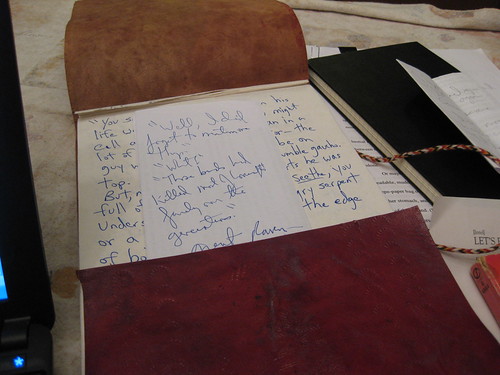
Case in point—the photograph above. On the left is a leather-bound, hand-made writing pad I bought in Victoria on Vancouver Island while on my honeymoon. I’d had it in the closet in my office ever since then, more than seven years. Every time I pulled it out, I put it back in the closet again. The thing just seemed so nice, so opulent, that I couldn’t imagine writing in it. And yet I’d bought it because it was tantalizing–it suggested adventures I’d never write about in any other journal.

Well, this past week I finally found the perfect use for it. The paper inside is perfect for writing, but also perfect for art. I’ve started a rather odd story that includes extensive illustrations, and no other writing pad I have gives me the same sensation of effortless motion while both writing and drawing. Even the odd size of it helps, because it better accommodates the art and the words. Suddenly, everything about this impulse purchase that turned me off is helping me get into the groove of writing, energizing me, and recharging my imagination.

Meanwhile, next to it in the photograph is a plain black Moleskine notebook. In it, I’ve written several book reviews and a new short story–a very conventional, Southern Gothic-style story. The utilitarian look and feel of the notebook seems to help me keep focused and on task. I could no more write the reviews and the Southern Gothic story in the opulent oversized writing journal as I could create the illustrated strange story in the Moleskine. Each is perfect for its particular purpose.

So my question to you, because I’m curious, is: Have you had similar experiences with your writing tools, your writing surfaces, your writing life?

Happiness as a By-Product: An Interview with Jessa Crispin, Founder of Bookslut.com

Back in August of 2009, Jessa Crispin, the founder of Bookslut.com (I wrote a comics column for them for a year) posted a short essay on The Smart Set about writing and the writing life that referenced Booklife, largely in a negative sense. This caused me quite a bit of anguish, to be honest. It’s one thing to get a negative review on a novel; it’s quite another to think, even for a second, that you might have written something actively harmful to people.

I intended Booklife as a helpful guide that combined advice on how to navigate your way through the myriad of potentially distracting and useless tools and opportunities provided by the internet with modern advice on a host of more personal issues related to writing and being a writer, based on 25 years of experience. Crispin saw it at least in part as potentially manipulative or cynical, and placed it in the context of the many new “get-rich-quick” books that detail how to do internet marketing and the like.

After a more careful examination of her essay, however, I came to the conclusion that a difference in defining terms like “contact” might be part of the problem–that, in fact, whether you were to call someone a “contact” or an “ally,” the same points applied: in all of your dealings with other people, whether about your work or generally, be a sincere human being.

Of course, there’s also the uncomfortable truth that no one is ever going to perceive your book exactly the way that you intended for it to be perceived. In coming into contact with the world the text changes, given an additional dimension by readers. Nor do I think Booklife is perfect–part of the point of the book is to continually test it, to not only use it but to also define yourself as a writer by what you disagree with in the text.

That said, I decided it would be interesting to interview Crispin about issues related to the modern writer’s life and Booklife. The results are great—rock-solid advice and insight.

At least one of her answers deserves special emphasis, since I think it’s becoming a major problem in the largely hierarchy-blind world of the internet: “I do worry a little that the modern age has taken the failure stage out of the creative process. Now if you can’t get your manuscript published, it’s because the publishers are cowards, can’t see your genius, and you can self-publish it (and then send out slightly crazed emails to critics). There is a lack of humility, a failure to recognize that getting knocked on your ass is actually good for you.”

There’s also nothing in her answers that I would disagree with; indeed, there’s nothing in Booklife that would intentionally contradict the idea of focusing on the craft and art of fiction over the need to promote your work. Does that mean I won’t be making some changes in the second edition? Not at all, and one of those changes will be to add an introduction to the Public Booklife section that references Crispin’s Smart Set essay, and makes doubly or triply clear the context in which I am providing that information.

So, without further preamble, an interview with Jessa Crispin—with sincere thanks to her for doing the interview.

Continue reading →
Friday’s Links: Ancient Books, Future Fears and Talking Cats.

MacMillan CEO John Sargent opens up about ongoing talks with Amazon.

The US Department of Justice voiced its objections to Google Books, citing that plans for a vast digital library could lead to a monopoly.

Hachette Book Group signed on to provide books for Apple’s iPad.

While digital devices like e-readers continue to gain popularity for storing and disseminating information, some scientists wonder what might happen in the event of a “digital doomsday.”

Author Susan Morgan’s death ruled a suicide. Readers may know her better by her pen names: Zoe Barnes and Sue Dyson.

Author Cat Valente offers several reasons why writers shouldn’t be so eager to see the end of traditional publishing.

A cellphone novelist has managed to sell her book to St. Martin’s Press.

The Guardian asks if it is vanity to self-publish.

Yen at the Book Publicity Blog weighs the pros and cons of Facebook profile pages vs. fan pages.

Take a look at The Dresden Codex: the oldest book in the Americas.

n653213921_1671825_1056996Matt Staggs is a literary publicist and the proprietor of Deep Eight LLC, a boutique publicity agency utilizing the best publicity practices from the worlds of traditional media and evolving social technologies. He has worked in the fields of public relations and journalism for almost a decade. In addition to his work as a publicist, Matt is a book reviewer and writer whose work appears in both print and web publications.