Perchance to Dream: Tapping Your Infinite Creativity

John R. Fultz is the author of the novels Seven Princes and the forthcoming Seven Kings, both from Orbit.  A native of Kentucky, he now lives in the North Bay Area, California. 


All human beings are also dream beings. Dreaming ties all mankind together. –Kerouac

It occurs to me that the act of writing, especially in the fantastic and speculative genres, is very much like the act of dreaming.

When we sleep, our subconscious mind constructs vignettes, narratives, adventures, terrors, and dramas for our dreaming mind to inhabit. The architectures of our deepest selves come bursting to life, and even though we sometimes feel at the mercy of our dreams, it’s worth recognizing that it is actually we, the Dreamers, who create our dreams.

In this respect, everyone is a writer. A writer of dreams, if nothing else. Scientists tell us that dreaming is an essential human function–those who cannot dream eventually go mad. Dreaming allows us to confront our deepest fears and desires, often without realizing that we are doing exactly that. It’s as if something essentially human inside us is writing stories that are crucial to our spiritual, mental, and emotional health.

We are born dreamers; in that same vein, we are born storytellers. What could be more human than telling stories? It’s one of our oldest and most primal skills…from fireside grunts to cave drawings to stone tablets and right on up to paperbacks and best-selling fiction.

The same deeply ingrained creativity that subconsciously creates dreams also creates the stories we write in our conscious hours. I know writers who have dreamed entire novels before (or while) writing them. Robert Silverberg’s SON OF MAN was written in this way. I’m sure the same has been done with short stories. How many of you reading this have turned the nugget of a dream into a full-fledged story–or a whole book?

I am accustomed to sleep and in my dreams to imagine the same things that lunatics imagine when awake. –Descartes

There is a definite, if mysterious, link between our ability to create convincing, immersive, powerful dreams and our ability to write fully realized fiction. In effect, when we write we are dreaming while awake. Our conscious mind shapes, hones, and transcribes these dreams, but it is the infinite font of creative consciousness that dwells deep inside all of us that serves as the soil in which these stories grow.

In other words, every story or book you write is a combined effort: the conscious and subconscious mind working in tandem to produce the desired results. Often, writers find themselves on a journey of discovery. Many of us know where we’re going, but are surprised at how we end up “getting there.” We tap into our subconcious–which taps into the great Idea Pool–the Universal Consciousness–Jung called it the Collective Unconscious–and we “fish” for ideas, scenes, plots, characters, entire WORLDS. We are the miners of dreams, turning raw stones into diamonds with our dedicated efforts.

When we write, we dream. When we dream, we write–if only for an audience of one.

Isaac Asimov once said “Writing, to me, is simply thinking through my fingers.” I submit that writing, for us all, is actually DREAMING through our fingers. Undistilled dreamstuff, flowing like lifeblood from the center of our being along the conduits of our arms, into our fingertips and so into the keyboard (or pen). That immortal flow continues, right onto the printed page (or screen), and directly into the heart-minds of our readers.

Therein lies the magic and majesty of the written word. It’s how we share our dream-visions across space and time. It can even provide us with a certain kind of immortality; the writer’s words often live far longer than the writer.

Dream no small dreams for they have no power to move the hearts of men. –Goethe

When I’m deep into the writing process on a novel (or even a story), my conscious mind is so involved with the story I’m weaving that when I go to sleep my dreaming mind often takes over. I write stories over and over in my dreams… often watching them play out before me in part or whole. Sometimes I emerge from this state of dream-writing and I’ve suddenly solved a problem in the narrative, or “caught” a great idea that seemingly came from nowhere. When your mind is in “high gear” crafting stories, it doesn’t want to stop–even when you sleep.

All of this culminates in some valuable advice for writers: Pay attention to your dreams.

Listen to that Sleeping Narrator because it is your direct line to the source of infinite creativity. If you’re having trouble with a story, try sleeping on it. Let your unconscious partner, your Sleeping Narrator step in and give you a hand. You can also try some transcendental meditation for tapping creativity…but that’s a subject for another day.

Dream On, Brave Dreamers…

Man is a genius when he is dreaming. –Kurosawa

A Critique Template for Authors and Writer’s Groups

Patrick Hester is an author, blogger and Hugo Nominated Podcast Producer/Host who writes science fiction and fantasy. He is represented by Bob Mecoy for his fiction. His Functional Nerds and SF Signal weekly podcasts have both been nominated for Parsec awards and the SFSignal podcast is nominated for a 2012 Hugo Award. You can usually find him on twitter when he’s not writing (or even when he is).


A couple of years ago, I wanted to take the next step in my journey to become a published author. For me, that meant joining a writer’s group and getting some feedback from other authors. I found a well established group (founded in 1996) with a good mix of authors (folks who write poetry, science fiction, fantasy, horror, general fiction) and, after a few months of visiting (similar to auditing a college class except I was expected to read all of the material and comment/critique as well), I was welcomed as a member and could submit my own stories.

The critiques I received were well thought out, composed and, most importantly, helpful. So much so, that I started feeling guilty about my own critiques. At times, I would read a submission and stare at a blank page without a clue what to write. Over the next few months, I noticed a pattern. Some folks talked about plot, others were focused on characters, sentence structure, syntax, grammar and even dialogue. No two critiques were the same but when you put them all together, you had the big picture. I wanted to reciprocate and offer up the best critiques possible, so I created a form – a critique template I could use for every submission. With it, I can deliver a consistent and, more importantly, useful critique to the author.

Today, I’d like to share that form with you and look at each section.

Header

Here I have the Story Title, Author, Date and my own contact information in case the author wants to follow up with me later. In General Thoughts, I want to summarize my Initial Impression of the story, list the Pros and the Cons and deliver the Bottom Line – did the story work for me?


Plot

How was the Pace and Flow? If I struggled reading through for some reason, or couldn’t stop turning the pages, I need to note that here. What were the Strong Areas of the plot? Maybe it was the development of the main character’s backstory. Weak Areas –- was there an info dump that put the brakes on? Loose Ends – you mentioned a snickerdoodle in a way that made it seem important, but never returned to it or explained why. Stand Out Moments –- Holy crap that was the best fight scene ever! Stumbling Blocks -– your faster-than-light travel depends on thousands of gerbils running in little exercise wheels, and that just doesn’t work for me… Comments –- add anything about the Plot that doesn’t fit into the spots above.

Characters

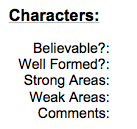
Are the characters in this story Believable? This is subjective, I know. Did you believe that the cop in the story would rob someone? Would the drunk anti-hero save a kitten from a burning house? Are the characters Well Formed? Is there enough detail to let you immerse yourself in the character? What are the Strong Areas of the characters? What are the Weak Areas? Comments – add anything about the Characters that doesn’t fit into the spots above.

Sentence & Paragraph Structure

People either have a lot or a little to say about this section. For me, I narrowed it down to two areas where I feel comfortable commenting: Vocabulary and Word Territory. Vocabulary is important (especially in a short story) and I like to point out where someone has done really well or where they could improve by changing out just a few words here and there.

As for Word Territory, well, this is basically where the author uses the same word or phrase enough that it stands out in the text. I tend to circle these words on the manuscript, drawing lines between them so the author can see them flipping through. Then I list the major instances here. Example: “Search your document for ‘that’, ‘quickly’ and the phrase, ‘working up the courage’ – you use these a lot.” For myself, I recently cut the instances of the word ‘that’ in my novel manuscript down from 1,147 to 659! Comments – add anything that doesn’t fit into the spots above.

Dialogue

Even if you get everything else ‘right’, a character’s dialogue/voice can take the reader out of the prose if it doesn’t flow correctly or feels forced or wrong. I have personally had people point out a bit of dialogue that they felt belonged to a different character in the manuscript – and they weren’t wrong. In this section, I point out Strong Areas that stood out to me, and Weak Areas that could use some work. Comments – add anything that doesn’t fit into the spots above.

General

This section is for a couple things that don’t fit anywhere else: Readability and Conflict. Readability goes to the manuscript as a whole – is it readable from start to finish? Conflict is about the conflict within the manuscript, the challenges that the characters have to face or work through. Did it work for you? Was it believable? How about the resolution(s)? The Comments space is for all other comments or thoughts you might have on the manuscript that just didn’t fit in a section above.

Bullet Points

As I am reading through a submission, I might have a thought or reaction to a scene, passage or bit of dialogue. I put a number and circle it at these points, then use the Bullet Items section to gather those thoughts for the author.


There you have it –- my Critique Template. This is not meant to be the definitive source, just a starting point. Many people in my group have already modified this template for their own style and to include areas they prefer to comment on. You can too -– I’m offering up this template as a free download. Use it well.

As a last thought, don’t focus on fixing everything. Be positive where you can and provide encouragement when it is deserved. Yes, you want to help the author produce the best story possible, but your critiques should be constructive, not crushing.

Tie-In Novels as Historical Fiction

Dave Gross is the author of Prince of Wolves, Master of Devils, and the upcoming Queen of Thorns. His other recent work appears in the anthologies Tales of the Far West and Shotguns v. Cthulhu. You can read some of his stories for free at paizo.com or follow him on Twitter @frabjousdave or frabjousdave.blogspot.com.


After a couple of decades editing and writing for shared-world settings, I still enjoy playing in someone else’s sandbox. The advantages of building your sand castle in a popular setting make up for those occasions when you scoop up a cat turd. You can avoid those unpleasant surprises, or make the most of them, by approaching tie-in fiction as an archaeologist and historian.

Do Your Research

When approaching a tie-in project, you’ll start with either a wealth of source material—as in a big property like Star Wars—or with only a few pages of concepts—as in a brand-new setting like Far West. Each situation offers a different advantage. If your strengths lie in research and interpolation, you’ll love poring over dozens of volumes in search of details to bring your story to life. If the material is well organized, with a wiki for instance, it’ll be a breeze. With smaller settings, you’ll enjoy the freedom to invent within an established atmosphere. I’ve written novels for which my research filled a banker’s box and some for which my research fit on two pages.  Each method has its pleasures.

Obey the Canon

Whether you’re developing from existing elements or creating new ones, it’s crucial not to break with the established “physics” of the world. When pitching a story for a steampunk/wuxia/Wild West setting, I assumed incorrectly that magic was a part of the world. Thankfully that happened at the pitch stage, so the editor gently pointed out my mistake, and I moved on to a different pitch.  When I write for Pathfinder Tales, the editor asks me to footnote any mentions of spells or monsters from the game—or to point out where I’m inventing something new—to help him make sure my story jibes with the source material. As with any writing, the better your communication with the editor, the less pain you’ll endure in revision.

Resolve Existing Conflicts

Just like the real world, large settings like the Forgotten Realms occasionally produce conflicting references to a single location, time period, or character. Sometimes these vagaries are intentional, as with multiple interpretations of a religious prophecy. But discrepancies can slip through, just as archaeologists unearth contrary evidence or historians disagree in their interpretations of that evidence. If your editor can’t resolve the question and it’s left to you to make the call, make the most of it. Pick the interpretation that best serves your story, or the one that best reflects the “truth” of the setting. At the same time, trust your editor to make sure that writers working at the same time each have their own corners of the sandbox, minimizing conflicts.

Beware of Apocrypha

Fans love to add to their favorite tie-in settings, as do third-party-publishers (3PP). Take care to avoid both fan-created and 3PP content. Not only is that extra material unofficial, it’s also legally off-limits. This situation is especially dangerous to writers who have read widely from a setting’s source material.  Recently I discovered some fan-created material in a big folder of official source material, reminding me of this danger.

Extrapolate the Small Stuff

Even the most comprehensive setting won’t provide you with all the details you need for a rich story, and that’s where the real fun begins. You may know everything else about the goddess of death, but when you need the equivalent of the sign of the cross for a frightened character, it’s your moment to add a new detail. Some of my favorite additions to established settings have been the smallest: rituals, courtesies, and curses. The key is not to throw in something just because it’s cool by itself; it should make sense within the existing setting, so find a way to link the small to the big. For example, in a country where the authorities impale criminals on giant forks, “shooting the tines” might be the most offensive gesture. Do it well, and other authors will use your invention as their source material in the next book.


Writing tie-in fiction isn’t for everyone. Some precious souls look down on the work, despite its appreciative audience and many excellent examples of the form. And maybe you just don’t enjoy research; I know at least one brilliant writer who has done excellent tie-in work in the past but who avoids it now because it’s too much like studying for an exam. Still, if you’re a fan of a setting or its genre, if you play well with others, and if you do your research, you can have a lot of fun in the sandbox and uncover far more treasure than turds.

Planting the Decision Tree

Monica Valentinelli is an author who lurks in the dark. Recently, she released a science fiction novella titled “Redwing’s Gambit” which was based on the Bulldogs! RPG. She has over a dozen short stories published and two novellas with more on the way. For more about Monica and her work visit her website.


At some point in your career, you’re going to get some advice on what to do with your written works or your future as an author. Maybe the suggestions will originate from a peer or your mentor. Maybe it’s from an old teacher or a friend of yours. Maybe you spot something on a website just like this.

Getting inundated with advice isn’t always a good thing, because often pieces will conflict with one another or worse – derail you from your current manuscript. This article is geared to help you keep your focus on the page and weigh the benefits of what recommendations you encounter.

Here are a few decision tree matrices that will help you decide what’ll work best for you and your work:

  1. Knowledge – What background information are you required to know before you act on the advice that’s been given to you? How much time are you willing to spend researching the validity of the claim or learning the pieces you aren’t up-to-speed on? While you can’t put a price on knowledge, it is an intrinsic asset and one that may require more effort to attain in specific cases when technology, new forms of writing, etc. are involved.
     
  2. Achievability – Based on what you’ve been told, how many other authors have successfully replicated that same piece of advice? Or, are you willing to risk everything on the off-chance you’ll be “lightning in a bottle?” Another way of looking at whether or not a piece of advice is valid for you, is if the recommendation hyper-focuses on a trend. Just as one example: the latest zombie craze may sound like an opportunity in disguise, but what’s chic in fiction now has already been written, revised, and edited. If you can leverage that monster-of-the-day, great! If you can’t? Well, then maybe your forte is not braaaaaaaiiiiinnnssss.
     
  3. Relevancy – You know yourself and your work best. Ask yourself whether or not the advice is relevant to what you want to do, what you’re working on, and where you are now in your career. This is probably one of the most important qualifiers when you process information, because you’ll need to decide how well that fits with what your goals are. If you find yourself questioning your work to the point where you desire to change what you’re doing before it’s completed, then you may want to reconsider who and where your getting the recommendations from.
     
  4. Distraction – Will the advice prevent (or delay) your completion of what you’re currently working on? If yes, what benefits do you hope to gain from applying the advice and do they outweigh finishing your manuscript? This concept goes back to relevancy, but it also further clarifies whether or not you can acknowledge how the recommendation will negatively impact your manuscript or goals.
     
  5. Experimentation – If the advice given to you is a risk, is it one you’re willing to take? How much time do you want to spend experimenting versus strengthening your core competency? By identifying opportunities for trial-and-error when they arise, you can help shape where you want to go, provided you’re in a position to accept a positive or negative outcome. After all, speculative ventures are not guaranteed to work. That’s why they’re experiments.
     
  6. Data Crunching – Can the advice be backed up with good data? Would you be willing to use that data and apply it to your own career? Oft overlooked, data is crucial to any business owner who wants to make fact-based decisions. Mind you, good data can be difficult to obtain and it’s often a snapshot of a larger picture. The idea behind getting data in the first place is to have supported claims and avoid anecdotal bits of advice that are steeped in conjecture. Data removes the emotion right out of the equation and can help keep you grounded when you want facts.
     
  7. Financials – Will you be able to afford to take the advice you’ve been given? Or does it cut into your time to do other paying work? A lot of advice doesn’t always come down to the “M” word – money – but more often than not hidden costs can start to affect your pocketbook. In addition to time, stress is an invisible expense that can spur you to write or freeze your fingers. When you stop producing, whether they be short stories, novels, articles, etc. you affect your ability to monetize your work. Advice itself may not have a dollar sign attached to it; but the application of it can both positively and negatively influence your bottom line.
     
  8. Timeliness – Is there an expiration date on the advice? Does your success or failure rely on how fast you can complete the recommendation? The adage timing is everything is often true for pieces of advice that are not only time-sensitive, but also demand your full attention. Understanding the “what” and the “how” of what someone is proposing can pale in comparison to the “when.”
     

Hopefully, these eight concepts will help remind you what you already know, that advice is cheap if not free. However, nothing can replace the precious time you spend in front of your monitor, typewriter, or notebook writing. Regardless of what anyone says, you’re the only author qualified enough to shape where you’ll go. By training your inner voice to critically think about how the advice you receive applies to your work – you’ll be able to do just that.